A gym bag and a carry-on are often the same bag, especially once you are ordering branded duffels for a team, a studio, or a member range that people will travel with. That makes airline size limits a quiet but real spec decision. Order a duffel a few liters too big and it stops being something a member can take to the gate; keep it inside the right box and the same bag does double duty. Here is what the current airline rules actually say, where common duffel sizes fall against them, and how to spec a custom gym bag that travels without drama.
The one number that matters: 22 x 14 x 9
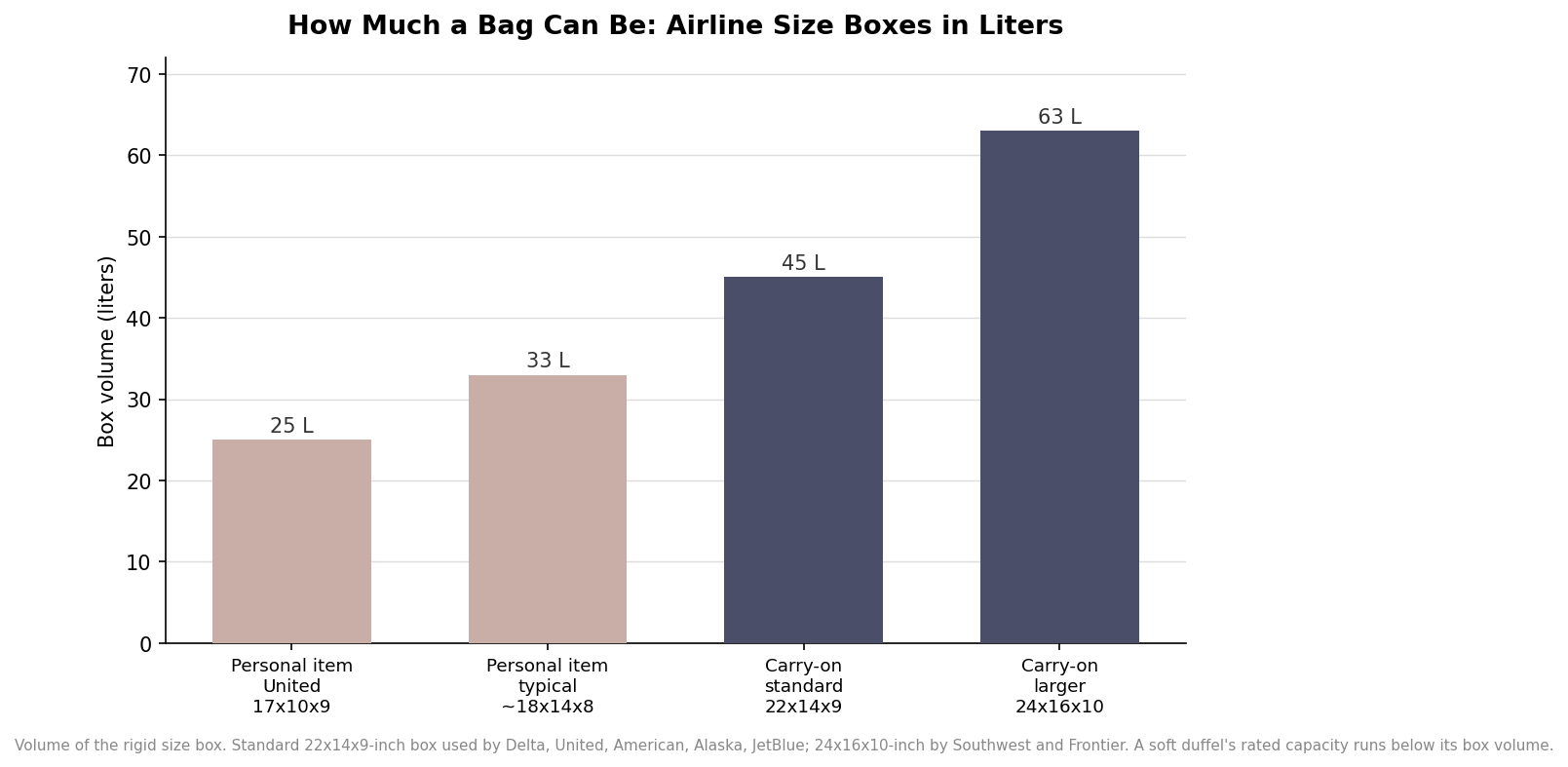
For carry-on bags, most major US airlines converge on a single dimension: 22 by 14 by 9 inches, wheels and handles included. Delta, United, American, Alaska, and JetBlue all use that box, so if a bag fits it, it clears the overhead bin on the majority of domestic flights. Two carriers are more generous. Southwest and Frontier allow 24 by 16 by 10 inches, which is roughly 38 percent more volume, and Spirit publishes a 22 by 18 by 10 box but charges separately for a carry-on and weighs it against a 35-pound limit. The practical takeaway is to design to the smaller, more common 22 by 14 by 9 box if you want a bag that works everywhere, and treat the larger allowances as a bonus rather than a target.
Converted to volume, that standard box is about 45 liters of rigid space, and the larger allowance is about 63 liters. Those are the ceilings a soft duffel is measured against, and the chart below puts the common airline boxes side by side. Note how much smaller a personal item is than a carry-on; that gap is where most sizing mistakes happen.
The personal item: the smaller box most people miss
Every carry-on discussion has a second, smaller box hiding inside it: the personal item, the bag that goes under the seat. Here the airlines diverge and, awkwardly, several do not publish exact dimensions. United states 17 by 10 by 9 inches. Delta does not publish a figure but the industry-standard working number is about 18 by 14 by 8 inches, similar to what Allegiant, Frontier, and Spirit use for their personal items. Southwest and Alaska sit a little smaller in practice. In liters, a personal item runs roughly 25 to 33 liters of box volume, well under half of a full carry-on.
Why this matters for a gym bag: a compact daily duffel in the 20-to-30-liter range can often ride as a personal item, which on basic-economy fares that do not include a carry-on can be the difference between paying a bag fee and not. If you are speccing a bag specifically to slip under the seat, design to the tighter personal-item box, not the carry-on one, and keep the depth modest since the under-seat space is shallow.
Where duffel capacity lines up with the limits
Duffels are usually sold by rated capacity in liters, so the useful question is which capacities stay inside which box. As a rough map, a daily gym duffel around 25 liters is personal-item friendly and easily a carry-on. A 35-liter weekender clears the standard carry-on box with room to spare. A 45-liter bag sits right at the standard carry-on ceiling, so it works but leaves no margin for overstuffing. Bags in the 50-to-60-liter range only fit the larger Southwest and Frontier allowance, and anything approaching 75 liters or more is a checked bag on almost any carrier. The chart below shows those sizes against the two carry-on lines.
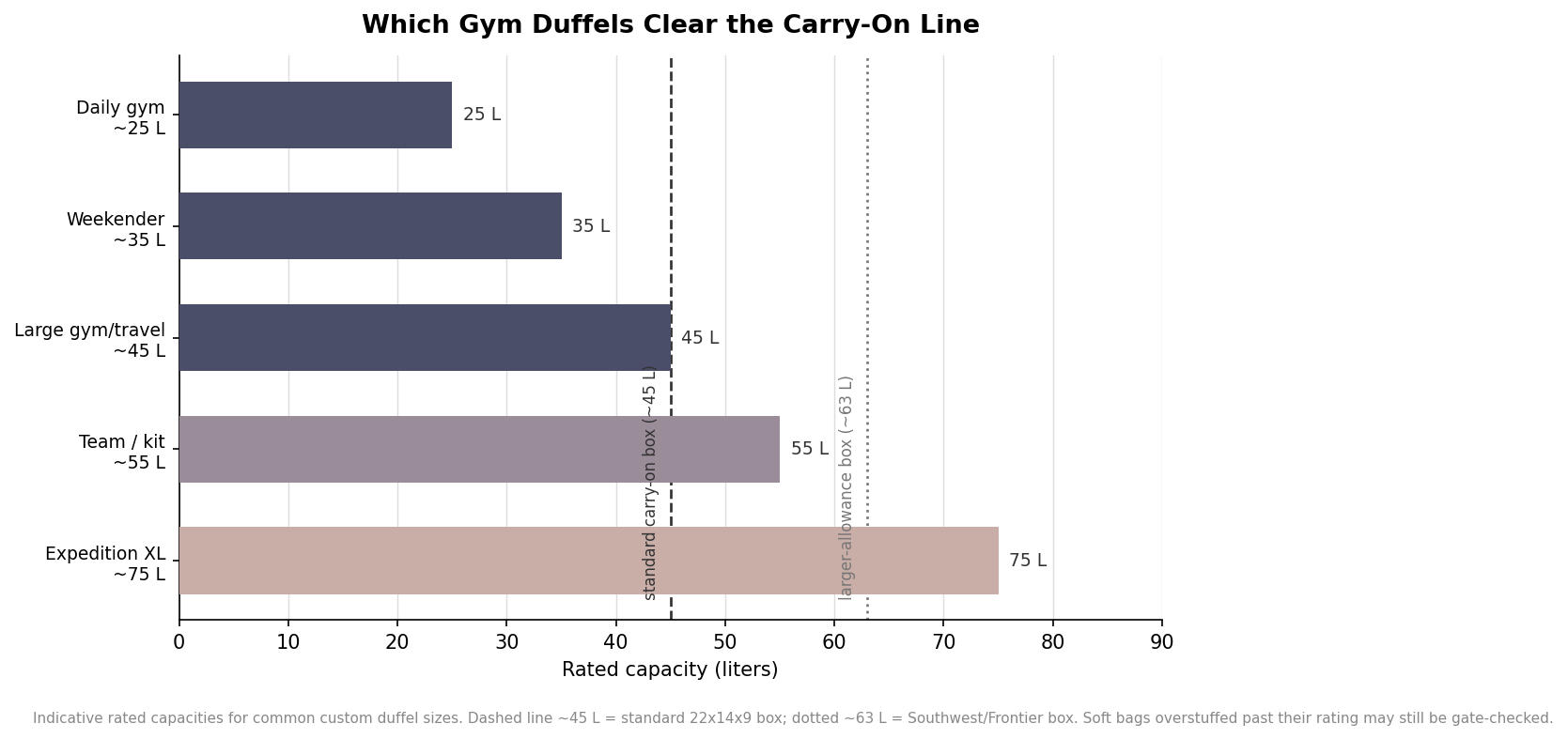
One honest caveat sits behind that chart. A duffel’s rated capacity and its physical footprint are not the same thing, because a soft bag can be underpacked to look smaller or overstuffed to bulge past its box. A 45-liter bag packed light will pass gate sizers that the same bag, crammed full, would fail. That flexibility cuts both ways, which is why the numbers here are a guide to the terrain, not a guarantee at any given gate.
Soft bags bend the rules, a little
The advantage of a duffel over a hard roller is compressibility. Frames, wheels, and rigid panels count against the size box even when the bag is half empty, while a soft duffel gives at the seams and can be squeezed into a sizer or under a seat. That is a genuine edge for travel, but it is not a license to ignore the numbers. Gate agents can and do check bags that look oversized, and an overstuffed duffel that will not compress gets gate-checked like anything else. The reliable approach is to spec the bag so its rated capacity sits at or below the box you are targeting, then rely on softness for the last little bit rather than as the whole plan.
Speccing a custom gym bag that travels
Translate all of this into an order and a few concrete choices follow. If the bag should work as a carry-on across every major US airline, keep the finished dimensions inside 22 by 14 by 9 inches and the rated capacity at or under about 45 liters. If it needs to double as an under-seat personal item, tighten to roughly 18 by 14 by 8 inches and 25 to 33 liters, and hold the depth down. Favor soft, structured construction over rigid panels so the bag compresses into a sizer, and remember that external pockets, bulky shoe compartments, and stiff bases all add to the measured footprint even though they are not in the capacity rating. Finally, because airlines revise these limits and budget carriers differ most, confirm the current dimensions for the specific carriers your buyers actually fly before locking a size. The figures here reflect published 2026 carry-on and personal-item limits and typical duffel capacities, and they will shift over time and by airline; use them to get the spec close, then verify the details that matter for your use.