Choosing a gym bag is the easy part. The decision that quietly determines whether your logo still looks sharp after a season of chlorine, sweat and gym-floor abrasion is how you decorate it. The same artwork can be embroidered, screen printed, heat pressed, sublimated, sewn on as a patch or debossed into a trim panel, and each route behaves differently on the coated nylon and polyester that most gym bags are cut from. This walkthrough covers how to specify decoration so the quote you get back matches the bag you actually wanted.
Start with the fabric and the panel, not the logo
Most gym bags are made from polyester in the 300D to 900D range or coated nylon, often with a PU or PVC backing for water resistance. That backing matters more than the artwork. A tightly woven, coated synthetic takes a needle differently than a soft cotton tote, and a slick laminated face rejects some adhesives that grip a raw canvas without complaint. Before you pick a method, identify the specific panel you want branded: the flat front pocket, the end cap, a woven webbing strip, or a structured base. A large main panel with a foam backer behind it is a good embroidery surface; a floppy unsupported gusset is not. Specifying the panel up front lets a decorator tell you which methods are even physically sensible, and it prevents the common disappointment of a crisp proof that puckers once it is stitched onto an unsupported area.
Embroidery: the default for structured panels
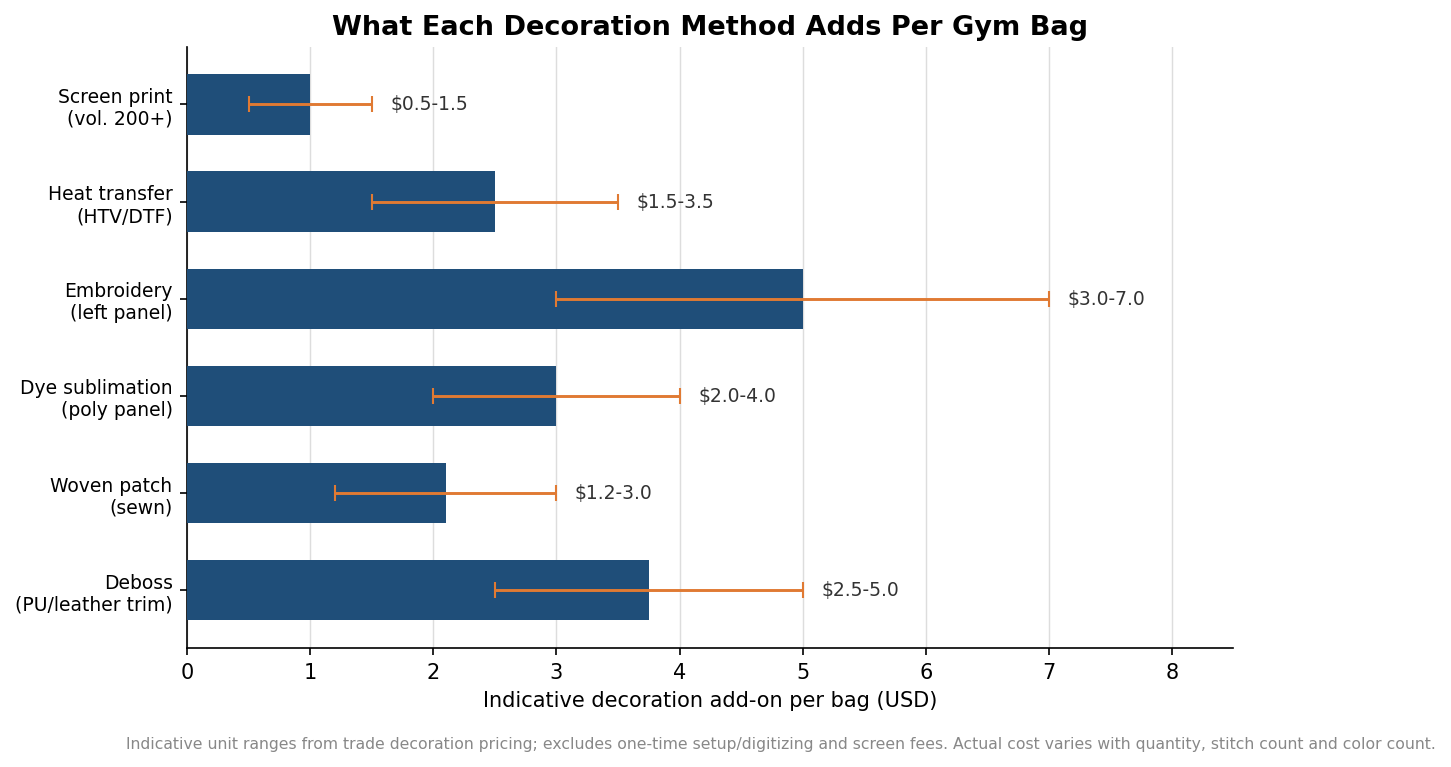
Embroidery is the standard for corporate and team gym bags because thread reads as durable and premium, and it survives washing and abrasion better than most printed methods. On synthetics you specify a few things beyond the logo itself. Stitch density typically runs 250 to 400 stitches per inch, and a backing or stabilizer is used behind the panel so the coated fabric does not distort as the needle works. Keep fine text above roughly a quarter inch of cap height; below that, letters tend to fill in and lose legibility because thread has a minimum practical line width. Thread color counts are generous, commonly up to fifteen in a single design, but the real cost driver is stitch count, not color. A dense, palm-sized crest costs more to run than a simple two-inch wordmark even if both use one thread color. Expect an indicative add-on in the region of three to seven dollars per bag for a left-panel logo, plus a one-time digitizing fee to convert your art into a stitch file. That digitizing charge is paid once and reused on every reorder, which is why embroidery gets cheaper the more times you run the same design.
Ink and film: screen printing, transfers and sublimation
When your artwork is flat, bold and low in color count, ink usually beats thread on price at volume. Screen printing pushes plastisol or water-based ink through a mesh and cures it at roughly 150 to 160 degrees Celsius. It is the cheapest route per unit once you are past a couple hundred pieces, but each color needs its own screen, so a one-time setup fee applies per color and gradients require halftones. Practical designs stay at or below six colors. Heat transfer, including modern DTF film, presses a printed film onto the bag at about 140 to 160 degrees for ten to fifteen seconds. It handles full color and small runs cheaply, which makes it the pragmatic choice for a dozen bags rather than a gross, though transfer edges can lift after heavy repeated washing, so it suits bags that see moderate rather than industrial laundering. Dye sublimation infuses ink directly into the fibers at 180 to 200 degrees and gives photographic, seamless color that never peels because there is no surface layer, but it only works on white or light polyester, so it is best reserved for bags or panels built specifically to be sublimated. If your logo has a metallic spot color or must hit an exact Pantone on a dark bag, tell the decorator early, because that constraint often rules sublimation out and points back toward embroidery or a printed transfer with an underbase.
Patches, debossing and mixed-material bags
Some bags are easier to decorate off the bag. A woven or embroidered patch is produced separately and then sewn or heat-sealed on, which sidesteps the problem of stitching directly through a laminated or awkwardly shaped panel. Patches are close to universal across canvas, nylon, leather, neoprene and mesh, and a sewn patch with six or more stitches per inch and a peel-force target in the range of ten newtons holds up well to gym use. Debossing presses your mark into a PU or leather trim tab under heat and pressure, typically 120 to 150 degrees against material three-quarters of a millimeter to two millimeters thick, using a custom die that runs a few hundred dollars to tool. It reads as understated and premium and cannot peel or fade because nothing is added to the surface, but it is monochrome by nature and only makes sense where the bag has a suitable trim panel. For bags that combine a canvas body with nylon pockets and a leather base, you may end up specifying two methods on one product, matching each to the panel it sits on rather than forcing a single technique across materials it does not suit.
Matching method to order size and budget
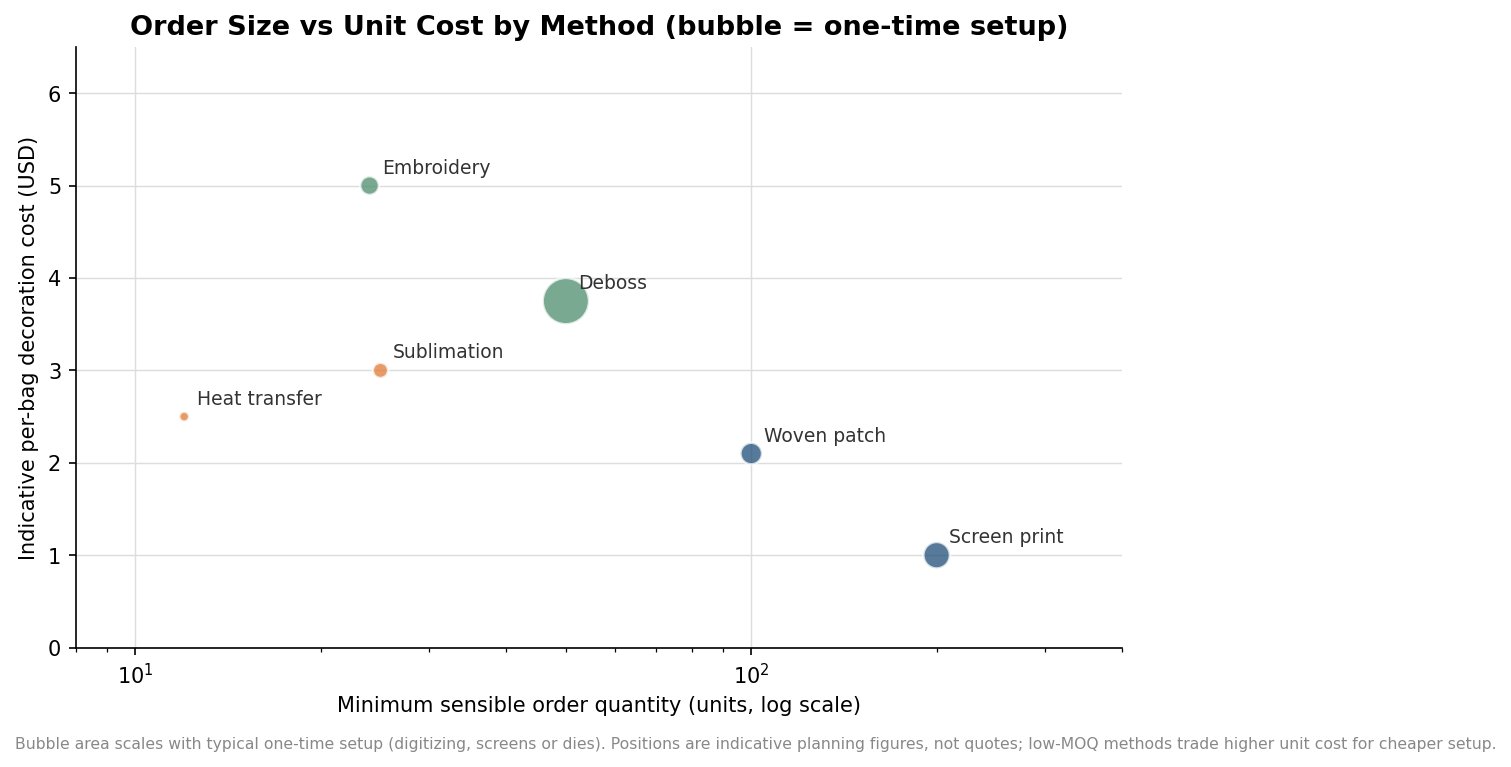
The last specification decision is really an economic one: how many bags, and how many times will you reorder. Setup-heavy methods reward volume, while film and transfer methods reward small, varied runs. Screen printing carries screen fees but drops to roughly a dollar or less per bag past a couple hundred units, so it wins for a large single-color team order. Embroidery carries a one-time digitizing fee and a higher unit rate, but it reorders cheaply and looks the most durable, which suits an ongoing branded range. Heat transfer and short-run sublimation carry little setup and let you produce a handful of bags affordably, at a higher unit cost, which fits event giveaways or sample runs. The chart below plots those trade-offs so you can see where each method sits before you request a quote.
Specify the bag fabric and target panel, the artwork’s color count and smallest text, your total quantity and your reorder expectation, and any hard constraints like an exact Pantone or a metallic. With those five details in hand, a decorator can point you to the method that keeps your logo intact through the washes, chlorine and daily abrasion a gym bag is built to take, rather than the one that merely looked good on the proof.