When a custom gym bag fails, it is almost never the fabric that gives out first. A panel of 600D polyester or 1000D Cordura will outlast years of gym floors and car trunks. What actually strands people mid-commute is a zipper that splits, a strap that tears away from its anchor, or a seam that unravels at the corner of the main compartment. These are hardware and construction problems, and they are the parts of a spec that buyers most often leave to chance. If you are ordering bags with your logo on them, the hardware is where your brand either earns trust or gets thrown in a closet.
This is a look at the components that fail first, what good versions of them cost you to specify, and how to write those requirements into an order so the sample you approve is the bag you actually receive.
The zipper is the single most important part
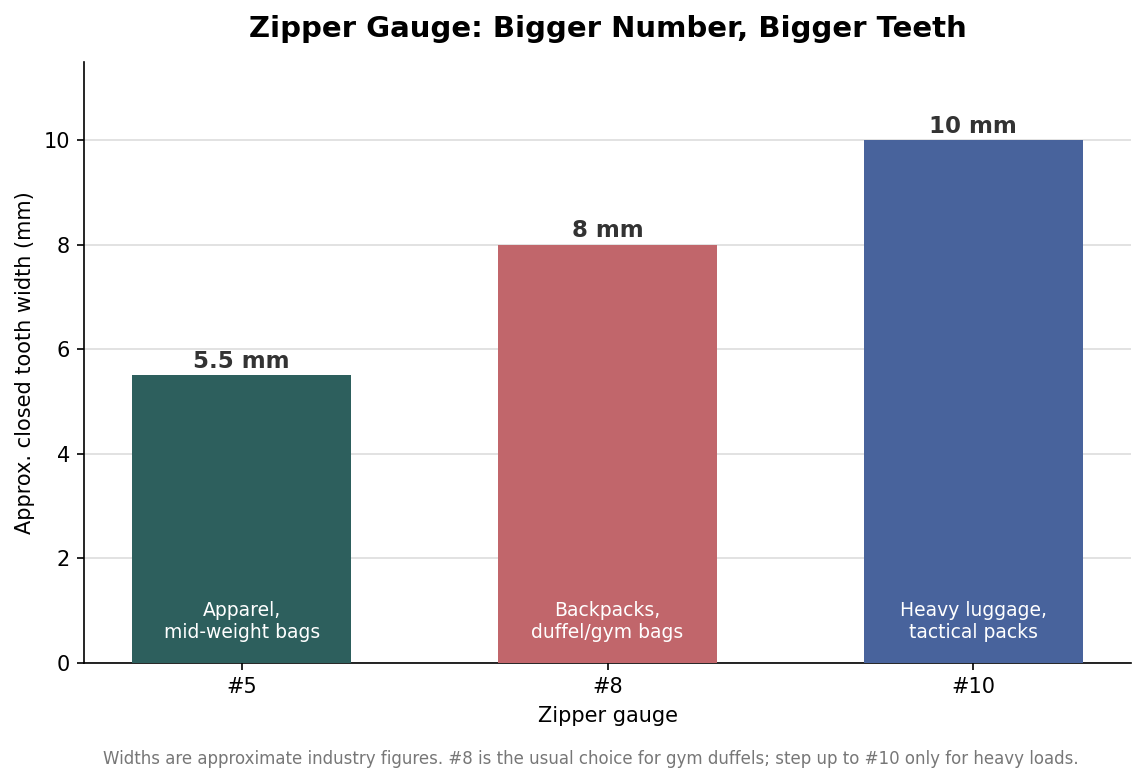
Ask anyone who has retired a bag early and the answer is usually the zipper. Zippers are sized by gauge, a number that roughly tracks the width of the closed teeth. A #5 runs about 5.5 mm and suits jackets and mid-weight bags. A #8 is about 8 mm and is the workhorse gauge for backpacks and duffel bags. A #10 is around 10 mm and is reserved for heavy luggage and tactical packs. For a gym bag, #8 is the right default; it takes the daily stress of an overstuffed main compartment without the bulk and cost of a #10. Reserve the #10 upgrade for oversized kit bags that get crammed past their rated capacity.
Gauge is only half the decision. Zippers come as coil or molded. Coil zippers use a spiral of nylon or polyester; they flex, shrug off grit, and tend to self-heal when a tooth is pushed out of line, which makes them forgiving on a bag that gets dropped in sand and dust. Molded zippers, often called Vislon, use individual plastic teeth; they are more rigid, stronger under a hard pull, and hold up better to sun exposure. For a gym bag that lives indoors and gets yanked open one-handed, a quality coil #8 is a sound choice. Whichever you pick, specifying a reputable maker such as YKK is one of the cheapest reliability upgrades available, and a sealed or water-resistant zipper is worth it on wet/dry and pool bags where moisture is the whole point.
Straps and handles fail at the anchor, not the middle
Webbing rarely snaps in the span you hold. It fails where the strap meets the bag, because that joint carries the entire loaded weight through a few square inches of stitching. Two things determine whether that joint survives. The first is the webbing itself: nylon webbing is stronger and more abrasion resistant, while polypropylene is lighter and cheaper but weaker and less durable under load. For a shoulder strap that carries shoes, water, and a day’s kit, nylon is the safer call, and polypropylene is acceptable only for light bags or non-load-bearing trim.
The second factor is how the strap is attached. The mark of a serious bag is bartacking at every stress point, a tight, box-shaped cluster of stitches that reinforces handle and strap connections far beyond what a plain straight seam can hold. When you review a sample, tug hard at the strap anchors and the handle bases and look for that dense box of thread. If the attachment relies on a single row of stitches, it will eventually pull through, no matter how good the fabric is.
Seams and thread are the quiet variables
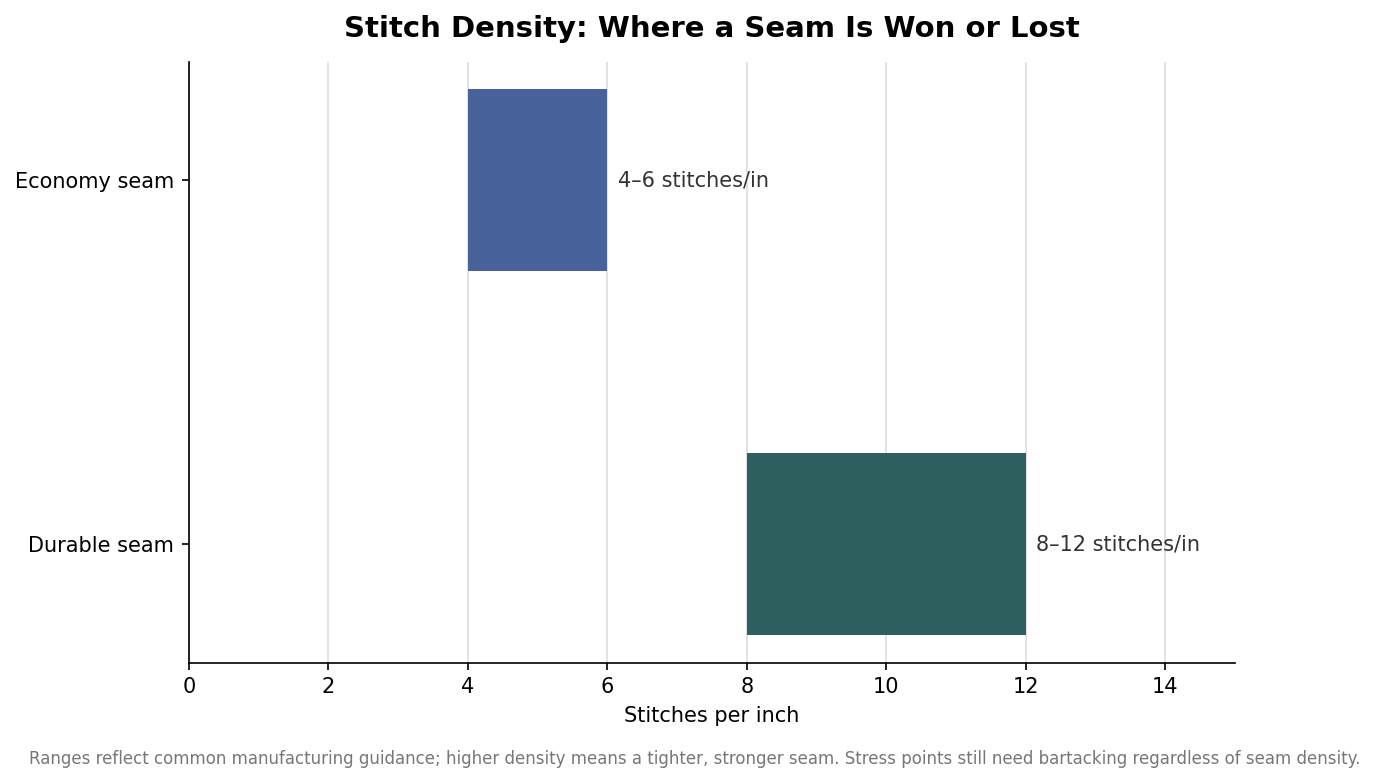
Two bags cut from identical fabric can differ enormously in lifespan because of the seam underneath. Stitch density matters: common manufacturing guidance puts a durable, tight seam at roughly 8 to 12 stitches per inch, while a rushed 4 to 6 stitches per inch saves the factory time and leaves a looser, weaker seam that works itself open. Thread matters too. Bonded nylon or polyester thread carries high tensile strength and resists abrasion inside the seam, where a cheaper thread quietly wears through.
The reason to care about numbers you cannot see is that they are exactly what gets substituted to hit a lower price. A supplier can quote the fabric you asked for, then win the bid on margin by dropping the stitch count, swapping to a lighter thread, or attaching straps without bartacks. None of that shows in a photo. All of it shows up six months later.
How to write hardware into your order
The fix is to make the invisible parts explicit in your specification instead of trusting them to the factory’s default. Name the zipper gauge and, ideally, the brand and coil-versus-molded type. Call for nylon webbing on load-bearing straps. Require bartacking at all handle and strap attachments. State a minimum stitch density and a bonded thread. Then, and this is the part most buyers skip, insist on a physical pre-production sample and stress it yourself: hang your body weight from the strap, run the zipper fifty times, and pull at the seam corners. A supplier confident in their build will not flinch at that request.
Fabric denier gets all the attention because it is easy to quote and easy to compare, but it is the least likely thing to fail. The zipper, the strap anchor, and the seam are what decide whether a branded bag becomes a bag someone carries for years or a bag they quietly replace. Spend your specification effort there, and the logo you paid to print keeps showing up at the gym long after a cheaper bag would have been retired.